


 Back to blogs
 Is cross-docking appropriate for your organization?

13 August 2025

Klaas-Jan den Hertog
In a world where speed, cost control, and delivery reliability are becoming increasingly important, cross-docking can be a smart solution. But what exactly is cross-docking? How does it work, and is it the right choice for your organization? In this blog, we explain the concept and show you what E. van Wijk Logistics can do for you.
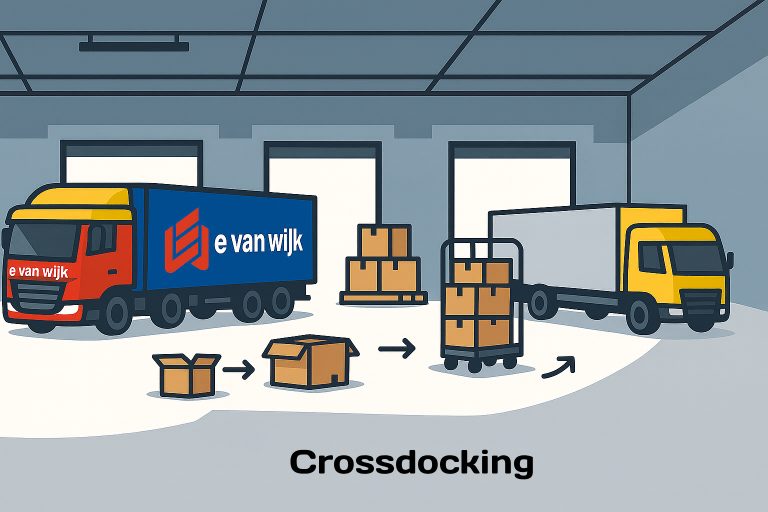
What exactly is cross-docking?
Cross-docking is a logistics method in which goods are stored little or not at all, but are immediately transferred upon arrival for further transport to their final destination. This largely eliminates the traditional warehouse process.
In practice, this means that a truck delivers goods to our cross-dock center, after which the shipment is immediately sorted and prepared for dispatch. This process can be completed within just a few hours, significantly reducing lead time.
The difference from storage is clear: in traditional warehousing, goods remain in stock for a longer period, resulting in extra handling and costs. Cross-docking, on the other hand, is all about speed and efficiency, with minimal storage time.
When should you choose cross-docking?
Cross-docking is particularly suitable for goods that need to be delivered quickly or for which storage is unnecessary. Think of perishable products such as fresh food, but also seasonal items or promotional goods with a short lifespan.
Industries that benefit most from cross-docking include retail, e-commerce, FMCG (fast-moving consumer goods), and automotive. In these sectors, demand is often time-critical, and reducing inventory costs is a major advantage.
What are the benefits of cross-docking?
The advantages of cross-docking are clear:
-
Speed and lower costs – Since goods are forwarded directly, lead times are shorter, and you save on storage and handling costs.
-
Less storage space and fewer handlings – You need less warehouse space, and the number of times goods are moved is minimized.
-
Improved delivery reliability – Faster throughput and fewer steps in the process lead to fewer errors and delays, making deliveries more consistent and predictable.
What do you need to get started with cross-docking?
A well-functioning cross-dock process requires tight planning, clear communication, and the right facilities. Key prerequisites include a properly equipped transfer location, sufficient capacity for fast throughput, and experienced staff to manage the process.
In addition, ICT support is essential. Real-time tracking, inventory management, and automated planning ensure that goods flows are perfectly aligned. This prevents waiting times and allows you to respond flexibly to last-minute changes.
Working with a logistics partner that has extensive cross-docking experience, such as E. van Wijk Logistics, gives you access to proven processes and an established transport network.
Is cross-docking the right choice for your organization?
Before switching to cross-docking, it’s important to determine whether it fits within your supply chain. Use this checklist, for example:
-
Are your goods suitable for direct transfer?
-
Are your delivery times tight or seasonal?
-
Can you benefit from lower storage costs?
Common mistakes when transitioning to cross-docking include insufficient preparation, underestimating ICT requirements, and lack of coordination with suppliers and customers. If your goods actually require long-term storage or are often consolidated with other shipments, a traditional fulfillment or warehousing solution may be more suitable.
Ready to distribute smarter?
At E. van Wijk Logistics, we have many years of experience with cross-docking for different industries and flows of goods. We support you in setting up an efficient process, including integrations with your systems and optimal use of our network.
Would you like to know how cross-docking can make your logistics faster, more efficient, and more cost-effective? Contact us for a free analysis. Together, we’ll determine whether cross-docking is the right step for your organization.
